SSKK
All programmes

Sustainable agriculture

Almost every farm in Amreli and Gir Somnath is small, and almost everyone here depends on one. We work on the practices that cut cost and risk at the same time — better soil, less chemical, less water, and a farmer-owned company to bargain with.

The problem

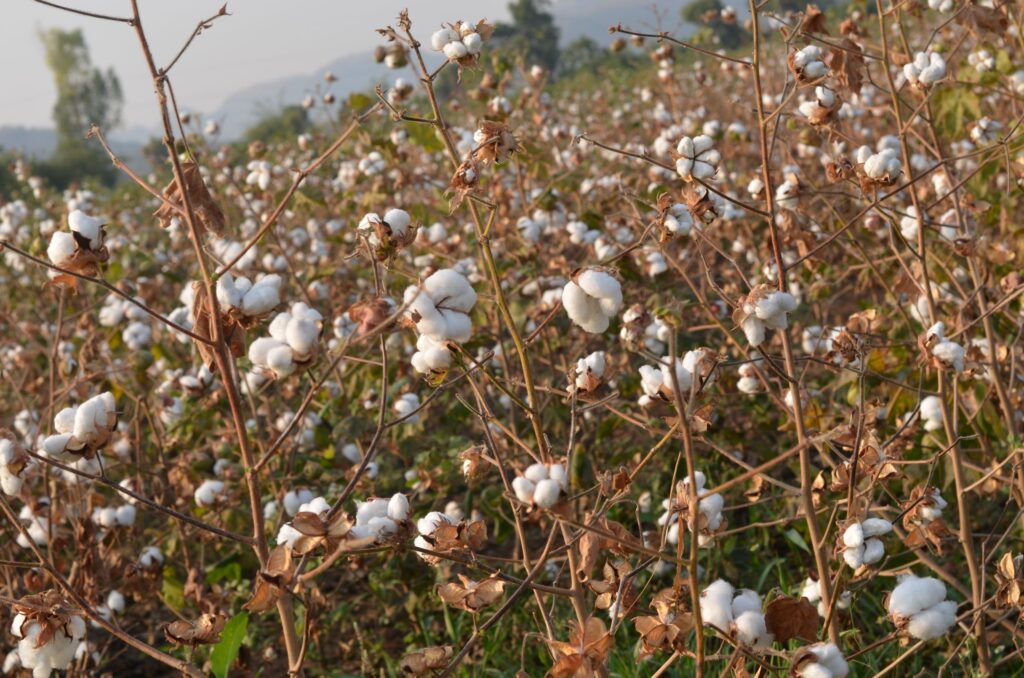
A small cotton farmer in Saurashtra is squeezed from both ends. Seed, fertiliser and pesticide are paid for in cash — usually borrowed — and cost more every season. The price at the other end is set by someone else. In between sits a monsoon less reliable than it was thirty years ago, on soil holding less organic matter each year. Most advice assumes a farmer can invest their way out. We start from the opposite end: the fastest gain available to a small farm is a cut in what it spends.

64%
of cotton farmers in this programme in India were using highly hazardous pesticides before training began Better Cotton India Impact Report, 2014-17 baseline
41%
were using Monocrotophos, classed as highly hazardous by the World Health Organization Better Cotton India Impact Report, 2014-17 baseline

What we do about it

Spend less before harvesting more

Identify the pest before reaching for the sprayer. Bio-pesticides, pheromone traps and fewer sprays. A soil card that says what to stop buying, not only what to add.

Use water on purpose

Measure what a field needs instead of flooding it. Drip and sprinkler sets, farm ponds and recharge structures — so there is still water for the last irrigation when the rain stops early.

Give farmers leverage

One small farmer has no bargaining power. A thousand, organised into a company they own, have some. We support two producer companies on governance — and do not run them.

Five farmers standing in a flowering cotton field around a solar light trap — a small photovoltaic panel, a battery box and a yellow trap body — with sesame flowering between the cotton rows
A solar light trap being shown to farmers in a cotton field intercropped with sesame. The trap draws moths at night and runs off its own panel, so it costs nothing to operate and replaces a spray rather than adding to one.

Where we work

Better Cotton programme, 2025-26. Amreli and Gir Somnath districts, worked through five producer unit clusters — Timbi, Dhokadva, Chital, Khambha and Lathi.

Blocks
7
Villages
126
Producer units
5
Learning groups
638

What this covers

  • Better Cotton — decent work, water stewardship and reduced pesticide load
  • Natural and organic farming — demonstrations, bio-input centres, exposure visits
  • Soil testing and integrated nutrient management
  • Micro-irrigation: drip and sprinkler systems
  • Farmer Producer Organisations for market access and price
  • Linking farmers to state schemes they rarely claim

What changed

A number on its own is not an outcome. Each one below says what it actually altered, and where it comes from.

−₹6,122

cultivation cost per bigha under groundnut intercropped with pigeon pea

Income rose ₹6,262 per bigha on top of that, on 4.72 fewer irrigations a season. Two crops off one field means a failed monsoon takes half the harvest rather than all of it — which is the point, not the yield.

SSKK Annual Report 2025-26

50

farm ponds built in Gir Somnath

Around 1,80,000 cubic metres of water held back over a monsoon — water for a last irrigation in a season when the rain stops early, which is the difference between a crop and a failed one.

SSKK Annual Report 2022-23

94%

survival rate of the 22,866 trees farmers planted in 2024-25

Planting is easy to count and easy to fake. Tracking survival a year later is what separates tree cover from a photograph — and 79,914 of these have gone in since 2021-22.

SSKK Better Cotton monthly report, March 2025

−53%

pesticide use across the Better Cotton programme in India

Farmers using highly hazardous pesticides fell from 64% to 10%, and Monocrotophos from 41% to 2% — less money spent, and far less exposure for whoever holds the nozzle. Irrigation water fell 29%.

Better Cotton India Impact Report, 2014-17 baseline vs 2021-22

442

farmers still using highly hazardous pesticides, counted in 2024-25

We publish this because a programme that only reports its wins is not measuring anything. Alongside it: 436 sprayed an unregistered pesticide, 347 used the same chemical group repeatedly and 335 mixed a cocktail. Each is a named, findable household to work with next season.

SSKK Better Cotton monthly report, March 2025

+₹4,350

extra net profit per bigha for one groundnut farmer, after a solar light trap

Rameshbhai Desai in Dolatpar lost part of his crop every monsoon to nilgai, wild boar and moths. A ₹4,200 smart radar solar light trap — of which he paid ₹1,600 — lifted yield from 600 to 660 kg per bigha. One farm, measured end to end, which is why it is here rather than in a training count.

SSKK case study, 2025

How we know — and what we do not

The pesticide figure above is a programme-wide result published by Better Cotton, measured across all its farmers in India — not a study of SSKK's farmers alone. We count practice adoption reliably. We do not yet measure income change on our own farms, and we would rather say so than imply a precision we do not have. Building that measurement is current work.

Results so far

Farmers trained in climate-resilient practice Cumulative to March 2025
30,000+
Farmers in the Better Cotton programme FY2025-26, including 2,752 women farmers
22,202
Hectares of cotton under improved practice FY2025-26, across five producer units
35,170
Soil samples tested Each with a personalised nutrient recommendation
1,030
Farmers who visited a demonstration plot FY2024-25, across 130 farmer field days
21,182
Farmers enrolled into producer companies FY2024-25
468
Bio-fertiliser produced by farmers
12,300 litres
Vermicompost produced
144 tonnes

How the training actually works

Field facilitators — most of them from the same villages — run learning groups through the season rather than delivering a lecture and leaving. The point of demonstration plots is that farmers change practice when they can walk into a neighbour’s field and see the difference. In 2024-25 we ran 130 farmer field days, and 21,182 farmers came to look.

Natural farming, and who already knows it

Chemical intensity shows up long after the season ends: degraded soil, contaminated groundwater, residues in the food and in the people who grow it. We promote the alternative by demonstration and by setting up bio-input centres, so that a farmer who decides to switch can actually buy the inputs locally.

Much of the knowledge this depends on — seed saving, kitchen gardens, livestock integration — is held by women. Scaling natural farming means treating that as expertise. Women are still only 12% of our Better Cotton farmers, which is well below where it should be.

Farmer producer organisations

SSKK promoted two, well before it became common practice: Avirat Agro Producer Company Ltd. (2006-07) and Sorath Agricultural Producer Company Ltd. (2016). They handle input aggregation, technical services and market linkage. An FPO that depends on an NGO to function has not succeeded, so we support governance and stay out of operations.

Support work that lasts.

Your contribution goes into long-term work across environment and climate resilience, sustainable agriculture, livelihoods, health, and knowledge sharing. All Indian donations are eligible for 50% tax deduction under Section 80G.