

Sustainable agriculture
Helping 30,000 farmers cut input costs, repair their soil and stay solvent through bad years.
Learn more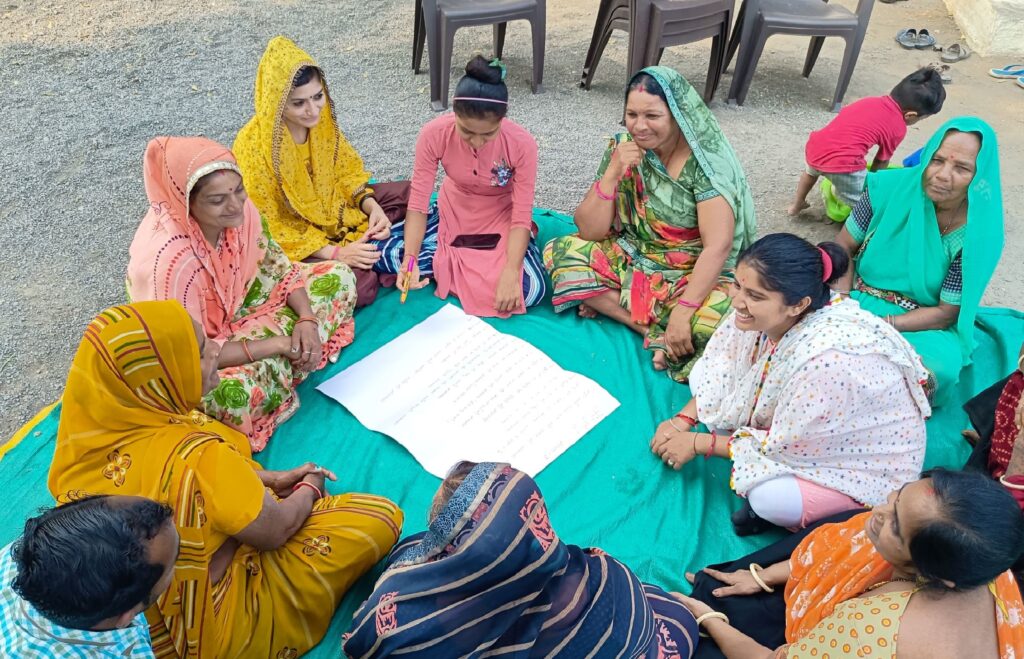
Development that depends on an NGO being present is fragile. This programme is about what stays after we leave — a Panchayat that plans from evidence, research honest enough to be useful to somebody else, and the unglamorous work of connecting a household to the scheme it is already entitled to.
Every Gram Panchayat in India is required to prepare a climate-resilient village development plan. A great many are prepared by copying last year's, because producing a real one takes a needs assessment, a functioning Gram Sabha and someone who knows how to converge line-department budgets. The same gap runs through everything else: most of what a rural household is entitled to already exists in a government scheme. The distance between entitlement and claim is where the poverty sits.
Data collection, focus groups, field observation of what services actually exist, need assessment, community feedback, a convened Gram Sabha. The output is a document; the point is the argument the village had while producing it.
Case studies and field research put out in full, including the parts that do not flatter us. Research nobody can check is marketing.
Knowing which department holds which budget line, which forms are needed, and who to sit with to move an application. It does not photograph well and it is often the highest-leverage thing we do all week.

Across our working area in Amreli, Gir Somnath and Rajkot.
A number on its own is not an outcome. Each one below says what it actually altered, and where it comes from.
60
climate-resilient village development plans facilitated
A plan built from a real needs assessment commits budget lines a copied one does not. It also survives us: the Panchayat keeps the document and the habit of using it after the programme ends. The number doubled from 30 in the last year.
SSKK programme records, to March 2026
12
families who installed biogas plants after 16 village meetings
A household that cooks on biogas stops buying or gathering fuelwood, and the kitchen stops filling with smoke. It also shows what convergence work looks like in practice — the subsidy already existed.
SSKK Annual Report 2022-23, with DRDA Amreli
3,021
applications carried through to a government scheme in 2025-26
Twice the 1,495 of the year before. None of this is new money — every rupee already existed in a budget line, in schemes the household was entitled to and had not claimed. What was missing was somebody who knew which form to file, and doubling the number is a measure of how much was going unclaimed rather than of how much was created.
SSKK programme records, 2025-26
873
E-shram cards obtained — 506 farmers and 367 farm workers
An E-shram card is what makes an informal worker legible to the state: without one, accident cover and welfare schemes simply do not reach them. The card outlasts the programme that helped fill in the form.
SSKK Better Cotton monthly report, March 2025
4
case studies published in full
Findings other organisations can use, check and disagree with. Two of the four are about what coastal farmers worked out for themselves, not about what we taught them.
Published on this site

The honest difficulty with this programme is that its successes are other people's. When a Panchayat plans well or a household finally claims a scheme, the credit belongs to them, and we have no clean way to show what would have happened otherwise. We report what we facilitated, not what we caused.
With training and financial support from Unnati and UNICEF, we drafted plans for Luvari Moli and Sultanpur in Gir Somnath as a pilot, in a deliberate sequence: data collection, focus group discussions, field observation, need assessment, community feedback, meetings with PRI members and government departments, a convened Gram Sabha, and a first draft.
Sixty Gram Panchayats have now been supported this way.
We also host students. Every year, people from IRMA, agricultural universities and public policy and social work programmes spend weeks in our field areas — 47 in 2021 and 2022 alone. They arrive to learn and leave having asked questions we had stopped asking ourselves, which is the actual value of the arrangement.
Helping 30,000 farmers cut input costs, repair their soil and stay solvent through bad years.
Learn more
Farm ponds, check dams, 1.4 lakh trees and 30 trained disaster-response volunteers — rebuilding the water table and the village's capacity to withstand a bad year.
Learn more
3,000 women trained in a trade, and the groups, credit and confidence to actually use it.
Learn moreYour contribution goes into long-term work across environment and climate resilience, sustainable agriculture, livelihoods, health, and knowledge sharing. All Indian donations are eligible for 50% tax deduction under Section 80G.