SSKK
All programmes

Environmental Sustainability & Climate Resilience

Amreli and Gir Somnath sit on the Arabian Sea coast, where salinity creeps inland as groundwater is drawn down and cyclones make landfall. We build the structures that hold rain where it falls, restore tree cover, and train the volunteers who respond in the first hour when a storm hits.

The problem

Everything else in this region is downstream of water. Crop choice, income, whether a family stays through the summer, whether a girl finishes school or spends her mornings walking to a hand pump. As groundwater is pulled out faster than it recharges, seawater moves inland through the aquifer. The wells do not run dry so much as turn brackish — which is worse. The water is still there, but it kills the crop and corrodes the pump. So the work has two aims at once: hold more rain on the surface, and push more of it back into the ground before it reaches the sea.

779
villages along the Saurashtra and Kutch coast affected by salinity ingress, across a 1,125 km belt Coastal Salinity Prevention Cell / Business Standard, 2018
Up to 90%
fall in crop yields reported in the worst salinity-affected coastal areas IndiaSpend, on saltwater ingress in Gujarat

What we do about it

Hold the rain where it falls

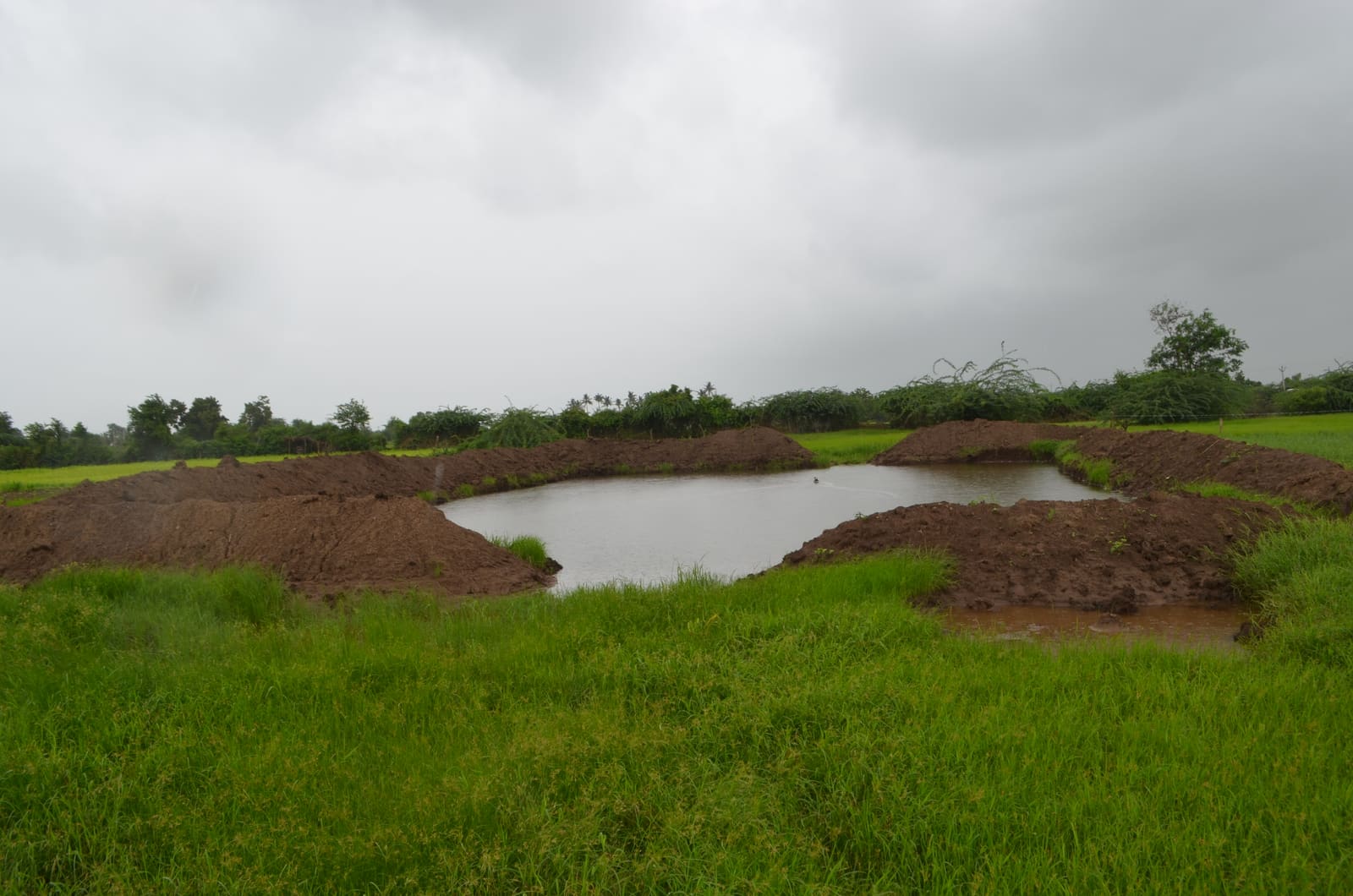
Farm ponds, field bunds and check dam deepening. Deepening an existing check dam is unglamorous and cheap next to building a new one, and it is usually the higher-return choice.

Put the trees back

Plantation run as a programme with survival tracked, not a photo opportunity. We push hardest on field margins — a tree on a bund shades soil, holds the bank and belongs to a farmer with a reason to keep it alive.

Prepare before the storm

Village volunteers trained for the first hour after a cyclone, and disaster risk written into the Gram Panchayat's own development plan so the preparation outlives any individual volunteer.

A JCB excavator deepening the silted bed behind a concrete check dam while two men watch from the wall above
Deepening a silted check dam in Rajkot district, January 2024. The wall was already standing — what had been lost was the storage behind it.

Where we work

Amreli, Gir Somnath and Rajkot districts. Figures to March 2025.

Villages with water work
39
Farm ponds
133
Structures repaired in Rajkot
73
Trained Suraksha Sathi
30

What this covers

  • Farm ponds, field bunds and check dam deepening
  • Coastal salinity prevention and groundwater recharge
  • Large-scale tree plantation and biodiversity corridors
  • Community water harvesting and drinking water access
  • Biochar, green cook stoves and reduced household fuel burden
  • Suraksha Sathi — village-level disaster response volunteers
  • Climate-adaptive farming plans built with Gram Panchayats

What changed

A number on its own is not an outcome. Each one below says what it actually altered, and where it comes from.

+5.73 ft

average rise in the groundwater table across the Rajkot project villages

Twenty-six check dams renovated and roughly 10 lakh cubic metres of storage created across 139 villages of Gondal, Kotda Sangani and Jasdan. A well that refills is the only measure that matters here — irrigated area per farm rose from 12.41 to 16.02 bigha off the back of it.

SSKK Annual Report 2025-26

261

open and bore wells recharged

A recharged well is the difference between a pump that lifts water and one that lifts brine. Recharge pushes back against the salt front rather than waiting for the aquifer to fail.

SSKK programme records, to March 2025

444 acres

brought under irrigation

Land that could only take one rain-fed crop can now carry a second. That is a change in what a household earns across a whole year, not a one-off transfer.

SSKK programme records, to March 2025

50

farm ponds in Gir Somnath, built with CSPC and Tata Trusts

About 1,80,000 cubic metres held over a monsoon — water for the last irrigation in a year when the rain stops early.

SSKK Annual Report 2022-23

94%

survival rate of the trees planted in 2024-25, checked a year on

Planting is easy to count. Survival is the number that decides whether there is tree cover in ten years. Through the cotton programme alone, 79,914 have gone in since 2021-22 — 20,684 then 16,740 then 19,624 then 22,866 — and they are counted again the following season.

SSKK Better Cotton monthly report, March 2025

30

Suraksha Sathi volunteers trained after Cyclone Tauktae

Trained neighbours reach a collapsed house before any agency does. The final training module writes disaster risk into the Gram Panchayat Development Plan, so a volunteer who moves away takes the training with them but the evacuation route stays.

Training with Unnati and UNICEF, Inter-Agency Group

How we know — and what we do not

We count structures, storage volume and wells recharged, and those we can stand behind. What we have not done is measure the water table across the intervention villages over time against comparable villages without it — the measurement that would actually prove salinity is being held back. It is the honest gap in this programme.

Results so far

Trees planted since 2021
1,40,114
Water structures built or renovated Check dams, farm ponds, field bunds and well recharge structures
231
Combined storage created
5.76 million ft³
Wells recharged
261
Land brought under irrigation
444 acres
Villages covered by water work
39

The structures, in plain numbers

Farm ponds — 133 built, 4.09 million cubic feet of storage, 467 acres covered for recharge and supplementary irrigation. A farm pond is the smallest useful unit of water infrastructure: one farmer, one monsoon’s insurance, and a recharge point for every well within a few hundred metres.

Field bunds — 120 hectares, protecting 111 farmers’ land. Bunds slow runoff so water soaks in instead of carrying topsoil away.

Check dam deepening — 1.21 million cubic feet of added storage, 185 acres irrigated for 158 farmers, 182 wells recharged.

In Rajkot district we repaired 73 community water harvesting structures, adding roughly 20.2 lakh cubic metres of capacity, and did drinking water work in 24 villages.

Household energy and soil carbon

Two small lines of work that matter more than their budgets suggest: 100 green cook stoves, cutting indoor smoke in kitchens where women spend hours a day; and 30 biochar demonstrations, turning crop residue that would otherwise be burnt into a soil amendment that holds water and carbon.

Climate-adaptive planning

2,520 hectares brought under climate-adaptive practice, 2,550 households supported to diversify food production, 314 soil micronutrient tests.

The point is not any single structure. A village that has planned for erratic rainfall — and has the Panchayat resolutions, the structures and the cropping changes to show for it — meets a bad year differently from one that has not.

Support work that lasts.

Your contribution goes into long-term work across environment and climate resilience, sustainable agriculture, livelihoods, health, and knowledge sharing. All Indian donations are eligible for 50% tax deduction under Section 80G.